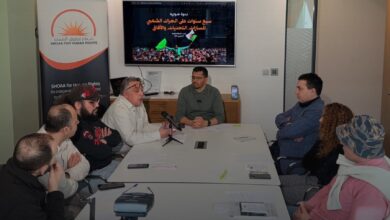
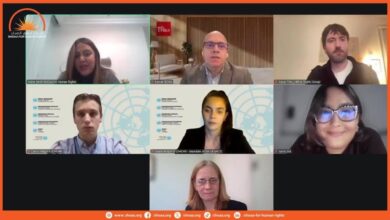
On 17 December 2025, SHOAA for Human Rights, in partnership with the International Peace Bureau (IPB), convened a webinar titled “Breaking the Silence: Restoring the Memory of French Nuclear Testing and Amplifying the Voices of Its Victims in Algeria.” The webinar addressed one of the most enduring yet overlooked legacies of colonial violence: the French nuclear tests carried out in the Algerian Sahara between 1960 and 1966, and their lasting human, environmental, and political consequences, but with a focus on victims’perspective.
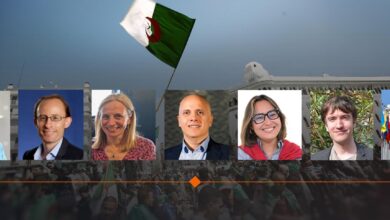
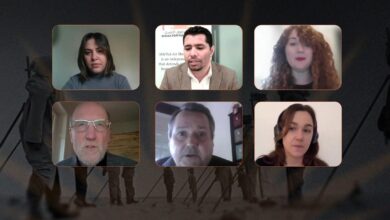
The discussion was moderated by Aigerim Seitenova, Founder of the Qazaq Nuclear Frontline Coalition, and featured interventions from Amel El Mejri, PhD in International Law and nuclear disarmament activist, Jean-Marie Collin, Director of ICAN France, and Dr. Patrice Richard, Co-President of AMFPGN–IPPNW France. Together, the panel brought legal, historical, medical, and advocacy perspectives to a conversation that placed the victims of nuclear testing at its centre.
Amel El Mejri focused on the legal and administrative obstacles that prevent victims from being formally recognised. She highlighted how existing frameworks often impose unrealistic evidentiary burdens on affected individuals and fail to account for the realities of colonial contexts, where documentation is scarce and access to information remains restricted. Reflecting on these challenges, she noted:
“”Recognition is not symbolic; it is the legal gateway to justice. Without recognising victims of nuclear testing as rights-holders, assistance, reparations, and remediation remain impossible.””
Dr. Patrice Richard provided a detailed historical overview of the French nuclear tests in Algeria. His intervention addressed the conditions under which the tests were conducted, the evacuation policies implemented by French authorities, and the specific impacts on populations living near the test sites. He also examined the role of civil-society organisations, the actions taken by former French Defence Minister Hervé Morin, and the responses of the Algerian authorities. In discussing claims for compensation and the persistent refusal of France to fully acknowledge responsibility, he observed:
“Progress for Algerians exposed to radiation from the 1960–1966 nuclear tests requires renewed diplomatic engagement between France and Algeria. More than sixty years on, contaminated land remains unmapped and affected populations insufficiently supported, making a joint commission and stronger victim-support mechanisms urgently necessary.””
Jean-Marie Collin addressed the responsibilities and actions of the Algerian authorities in dealing with the legacy of nuclear testing. He highlighted ongoing concerns related to nuclear waste, environmental contamination, and the absence of transparent and comprehensive strategies to address long-term risks to public health and the environment. Emphasizing the need for sustained political will and international pressure, he stated:
“I recommend that France should sign or at least be an observatory for the next TPNW meeting, and Algeria should ratify the TPNW as soon as possible to be able to participate as a legal state at the next review conference of member states.”
Across the discussion, speakers underscored that the legacy of nuclear testing in Algeria is not merely a historical issue, but an ongoing injustice. The absence of comprehensive data, limited access to archives, and the lack of effective victim-centred mechanisms continue to silence affected communities and delay accountability. The webinar reaffirmed the importance of international frameworks such as the Treaty on the Prohibition of Nuclear Weapons, particularly its provisions on victim assistance and environmental remediation, as essential tools for advancing justice.
The webinar concluded by reaffirming that SHOAA for Human Rights and the International Peace Bureau reiterate their commitment to amplifying the voices of victims of nuclear testing in Algeria and to working with international partners to ensure recognition, reparations, and environmental justice. Breaking the silence surrounding this legacy remains a necessary step toward accountability, dignity, and lasting peace.