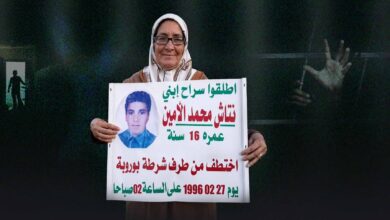
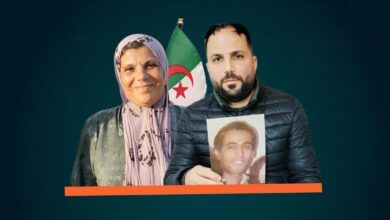
On 16 August 1994, Ammar Khaldi, the father of Yassine Khaldi, was arrested, according to the family’s account, at his shop in the Oued Rhiou market, Relizane Province, by members of the special forces known as the “Red Berets,” affiliated with Algeria’s Second Military Region, along with 27 other people. Around three hours later, security forces returned to the family home and searched it. Since that day, all trace of Ammar Khaldi has been lost, and his fate remains unknown.
More than thirty years have passed since his arrest, yet his family still does not know where he was taken or what happened to him. Since then, the life of his son, Yassine Khaldi, has become a long struggle to uncover the truth and determine his father’s fate.
Yassine became a prominent human rights defender and an active member of the National Coordination of Families of the Abducted, advocating for the right of families of the disappeared to know the fate of their loved ones and to obtain truth and justice.
He was also among the strongest opponents of the National Reconciliation Law because, in his view, it asked families of the disappeared to close a chapter whose truth they had never been allowed to know: the fate of the victims had not been established and justice had not been achieved, while those accused of violations remained beyond accountability. Yassine therefore maintained that genuine reconciliation cannot be built on silence, but must be founded on truth, justice and accountability.
But this struggle has come at a heavy cost. According to his testimony, he began facing security-related persecution in 1996 and was sentenced in absentia to ten years in prison, before benefiting from a special pardon in 2000. In the years that followed, he faced a series of arrests, judicial proceedings and periods of imprisonment in connection with his human rights activism.
One of the most significant episodes came in December 2019, when he was arrested and placed in pretrial detention before later receiving a prison sentence. During his detention, he went on a 20-day hunger strike to protest what he described as harsh prison conditions. He says he was subsequently placed in punitive isolation for one year.
The judicial proceedings did not end after his release. He faced several other cases and was later arrested again in a case in which he was accused of providing assistance to the families of detainees. During that detention, he launched another hunger strike lasting 17 days, before the Indictment Chamber ordered his release.
In December 2023, Yassine Khaldi met with Mary Lawlor, the United Nations Special Rapporteur on the situation of human rights defenders, during her official visit to Algeria, as part of his human rights work and continued advocacy for the disappeared and their families.
Yassine Khaldi’s story thus encapsulates more than three decades: a father arrested at his shop and then disappeared without a trace; a son who grew up searching for him, became a human rights defender, and faced arrest, prosecution and imprisonment without abandoning his demand for the truth.
On 30 August, the International Day of the Victims of Enforced Disappearances, his story is a reminder that the passage of more than thirty years cannot close a case while the fate of a disappeared person remains unknown and their family is still waiting for the truth.
Where is Ammar Khaldi? What happened to him after 16 August 1994?
Searching for a missing father is not a crime. Refusing to close the file of the disappeared without truth and justice is not a crime. There can be no genuine reconciliation without establishing the fate of the victims, providing justice to their families, and ensuring truth, justice and accountability.