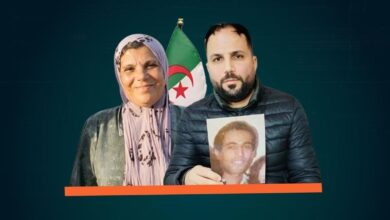
Since her son, Mohamed El Amine Nateche, was arrested on 27 February 1996, Fatiha Nateche, known as “Oum Amine,” has carried his photograph and searched for answers to the same questions that have haunted her for thirty years: Where is my son? What happened to him?
Where is my son? What happened to him?
Mohamed El Amine was only 16 years old when he was arrested at his family home in Algiers at around 2:00 a.m. by police officers from the municipality of Bourouba, in the El Harrach district, accompanied by members of military security. His family was told that he would be taken for questioning for only a few hours and then brought back home. But the hours turned into days, the days into years, and the years into three decades. Mohamed El Amine never returned.
From that night on, all trace of the 16-year-old disappeared, marking the beginning of a mother’s journey that has never ended. Fatiha Nateche carried her son’s photograph across numerous provinces of Algeria, taking part in gatherings and demonstrations demanding that the fate of the disappeared be revealed and raising awareness about Mohamed El Amine’s case. She also stood in solidarity with detainees, victims of violations, and others pursuing human rights causes.
When the authorities adopted the Charter for Peace and National Reconciliation, Oum Amine refused to accept financial compensation as a substitute for the truth or as an end to her son’s case. She was among the families of the disappeared who rejected financial compensation associated with procedures aimed at settling disappearance cases, insisting on her right to know Mohamed El Amine’s fate.
She also opposed the Charter because, in her view, it failed to provide justice to victims and their families and entrenched impunity for violations committed during the 1990s. For her, the case of a son who disappeared after his arrest cannot be reduced to financial compensation, nor can his file be closed before the most fundamental questions are answered:
Where is he? What happened to him? And who is responsible for his disappearance?
Oum Amine paid a price for holding on to these demands. Over the years of her activism, she faced restrictions and judicial proceedings, yet she continued to take part in demonstrations and never gave up carrying Mohamed El Amine’s photograph, refusing to allow the passage of time to turn her son into just another number in a file from the past.
Her story captures one of the cruellest realities of enforced disappearance: a mother saw her 16-year-old son taken from their home and was told he would return within hours. She then spent thirty years waiting for him.
On 30 August, the International Day of the Victims of Enforced Disappearances, Oum Amine’s story needs no new question. The question that began in the early hours of 27 February 1996 remains the same:
Where is Mohamed El Amine Nateche? What happened to him after his arrest?
Thirty years cannot extinguish a mother’s right to know her son’s fate. Financial compensation cannot replace the truth, reconciliation cannot be built on forgetting, and the case of a person whose fate remains unknown cannot simply be closed.
Thirty years later, Oum Amine still carries his photograph and waits for the truth — because Mohamed El Amine is not a closed file, but a son who has yet to return to his mother.