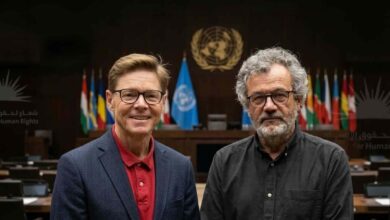
The organizations “Lawyers for Lawyers,” “SHOAA for Human Rights,” “The Law Society of England and Wales,” and the “International Bar Association Human Rights Institute” issued a joint statement regarding the arbitrary travel restrictions imposed on Algerian lawyer Mourad Zenati, a member of the Collective for the Defense of Hirak Detainees.
They called for the lifting of the travel ban, an end to his harassment, and for him to be allowed to carry out his professional activities without fear of retaliation. They also urged the adoption of all necessary measures to ensure that lawyers in Algeria are not subjected to harassment because of their work.
Read the full press release below:
Algeria: Serious concern over the ongoing harassment of human rights lawyer Mourad Zenati
Lawyers for Lawyers, SHOAA for Human Rights, the Law Society of England and Wales, and the International Bar Association’s Human Rights Institute express serious concern regarding the arbitrary travel restrictions imposed on Algerian lawyer, Mourad Zenati.
Mr Zenati is a prominent human rights lawyer and a member of “The Collective for the Defense of Hirak Detainees” (hereinafter the Collective), a lawyers’ group formed after the first wave of arrests of peaceful Hirak demonstrators in 2019. Lawyers in this Collective aim to defend those arbitrarily arrested, detained and prosecuted but have faced intensifying harassment from authorities in recent years. In April 2024, several of our organisations issued a joint statement highlighting our concerns regarding the escalating targeting of lawyers in Algeria.
On 9 August 2024, Mr Zenati was prevented from leaving the national territory at the Oum Teboul border post, due to a ban circular issued on 1 December 2022, by the Amizour Court in Bejaia. Mr Zenati was not notified of the court order and remained unaware of the restriction until he attempted to travel.
Our organisations are concerned that this travel ban has been imposed on Mr Zenati because of his professional duties and his association with the Collective. This is not the first instance of harassment that Mr Zenati has faced. In June 2022, he appeared before the Public Prosecutor at the Bejaia Court and was charged under the Penal Code with ‘undermining national unity’ (Article 79) and ‘inciting an unarmed assembly’ (Article 100) reportedly due to his posts on Facebook. While the charges are still suspended, he was not brought to trial, the actions demonstrate a pattern of intimidation.
Judicial harassment and limitations on freedom of movement have been identified by the UN Special Rapporteur on human rights defenders as two of the main patterns of violations used to suppress human rights defenders in Algeria, together with dissolution of key human rights organisations, and intimidation and surveillance.
As a state party to the International Covenant on Civil and Political Rights (ICCPR), Algeria has an obligation to ensure the right to freedom of movement. Any restrictions to that right, including the freedom to leave any country, must not be imposed arbitrarily, must meet the requirements of necessity and proportionality as set out in Article 12(3) of the ICCPR, and be consistent with the other rights recognised in the Covenant. We are concerned that the restrictions imposed on Mr Zenati’s freedom of movement are arbitrary, fail to meet the requirements of necessity and proportionality, and are inconsistent with other rights, including the right to freedom of expression and association.
Furthermore, in accordance with Principle 16 of the UN Basic Principles on the Role of Lawyers (UN Basic Principles), lawyers must be able to perform all their professional functions without intimidation, hindrance, harassment or improper interference; and must not suffer, or be threatened with, prosecution or administrative, economic or other sanctions for any action taken in accordance with recognised professional duties, standards and ethics. In addition, Principle 18 enshrines the recognised principle that lawyers must not be identified with their clients or their clients’ causes.
The travel ban imposed on Mr Zenati appears to violate the UN Basic Principles as it serves as a form of further harassment and interference due to his human rights work and legal services he has provided as a member of the Collective.
Accordingly, the signing organisations urge the Algerian authorities to:
1- Lift the travel ban and halt the harassment of Mr Zenati and any other members of the legal profession.
2- Ensure that Mr Zenati’s freedom of movement is not arbitrarily restricted in accordance with international law, and that he can conduct his professional activities without fear of reprisals and free from undue interference.
3- Take all necessary measures to ensure that lawyers in Algeria do not face harassment because of their work, including that they are not identified with their clients or their clients’ causes.
SIGNATORIES:
- Lawyers for Lawyers
- SHOAA for Human Rights
- Law Society of England and Wales
- International Bar Association’s Human Rights Institute