The debate surrounding Article 87 bis of the Algerian Penal Code is no longer merely a legal discussion; it has become directly linked to the future of freedom of expression and civic space in Algeria. Since the introduction of counter-terrorism provisions into Algerian legislation in 1995, the legal framework has undergone a gradual expansion through four successive legislative amendments in 2014, 2016, 2021, and 2024. Each of these reforms broadened, to varying degrees, the definition of terrorism, the scope of terrorism-related offences, or both, raising increasing concerns about the expansion of criminal liability.
A turning point came with Ordinance No. 21-08 of 8 June 2021, which significantly expanded the definition of terrorist acts through broadly worded provisions that have drawn sustained criticism from human rights organizations and United Nations mechanisms. In its report on the use of counter-terrorism legislation against civil society, SHOAA for Human Rights documented this development, concluding that the overly broad wording of Article 87 bis allows peaceful political, human rights, journalistic, and academic activities to fall within the scope of terrorism-related criminalization.
Since 2008, several United Nations human rights bodies and mechanisms have expressed concern regarding the compatibility of Algeria’s counter-terrorism legal framework with international human rights law. In its 2018 Concluding Observations on Algeria, the UN Human Rights Committee expressed concern that the broad and vague definition of terrorism under Article 87 bis could be used to prosecute conduct protected under the rights to freedom of expression and peaceful assembly. The Committee also warned against the misuse of counter-terrorism measures against human rights defenders and journalists and called on Algeria to adopt a definition consistent with the principle of legality and its obligations under the International Covenant on Civil and Political Rights (ICCPR).
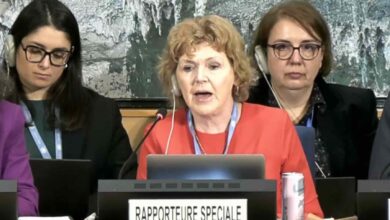
These concerns were reiterated by the UN Special Rapporteur on the rights to freedom of peaceful assembly and of association following his visit to Algeria in 2023, and later by the UN Special Rapporteur on the situation of human rights defenders, Mary Lawlor, whose 2025 report warned that the broad definition of terrorism undermines the work of human rights defenders and fosters a climate of fear and self-censorship.
The issue is not whether the State has the right to combat terrorism. Rather, it concerns the limits that must separate the legitimate protection of national security from the safeguarding of fundamental rights and freedoms. When peaceful political, human rights, journalistic, or academic activities can be interpreted as threats to State security, the problem lies not merely in the application of the law but in the law itself.
Throughout 2026, SHOAA continued documenting cases brought under Article 87 bis or related national security provisions against researchers, journalists, and activists, including Hassan Bouras, Mounir Seghir, and Mourad Atmimou, while also documenting cases involving prisoners of conscience prosecuted for the peaceful exercise of their right to freedom of expression. These cases reflect the continued use of security-related legislation in contexts involving the exercise of fundamental rights and freedoms.
These developments raise a fundamental question: what remains of civic space when citizens, journalists, researchers, or human rights defenders can no longer determine where freedom of expression ends and security-related criminal charges begin? The ICCPR, to which Algeria is a State Party, protects freedom of opinion and expression and permits restrictions only when they comply with the principles of legality, necessity, and proportionality.
Algeria does not have to choose between combating terrorism and protecting human rights. Both objectives can be achieved within the framework of the rule of law. This, however, requires counter-terrorism legislation to remain strictly limited to genuine terrorist acts and not be used as a tool to criminalize peaceful expression, human rights advocacy, journalism, academic research, or artistic creativity.
SHOAA considers that revising Article 87 bis has become a legal and human rights imperative to ensure the compatibility of Algerian legislation with the country’s international obligations, strengthen the principle of legality, protect civic space, and ensure that peaceful criticism and dissent are not met with criminal sanctions or security-related charges. A clear and precise counter-terrorism framework strengthens both the rule of law and national security without undermining the fundamental rights and freedoms that form the cornerstone of any society committed to its international obligations.