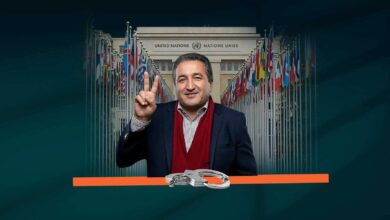
On September 7, 2024, Algeria experienced a political event that was supposed to mark a historic turning point toward democracy and social and political justice. The presidential elections were expected to rebuild trust between citizens and the state and to establish the principles of integrity and transparency in governance. Yet, one year later, it has become clear that the event merely reproduced the same mechanisms of authoritarian control, decorating an empty ballot box to provide cover for a power in search of lost legitimacy.
Repression of Freedoms: “Elections Under Intimidation”
No election can be called free if it is held in an atmosphere of fear. The 2024 presidential race was preceded and accompanied by a systematic crackdown targeting every space for expression and public debate. From the moment the election was announced, authorities resorted to intimidation: arbitrary arrests of political activists, continuous harassment of independent journalists, closure of media outlets not aligned with the regime, and violent suppression of peaceful protests.
This was not a mere administrative tightening but a deliberate policy aimed at crippling any genuine opposition and sending a clear message to society: “Elections will take place under our conditions, or not at all.” Fear spread widely, discouraging citizens from expressing their views and stripping the electoral process of its democratic content.
This reality blatantly contradicts Article 52 of the Algerian Constitution, which guarantees freedom of expression, freedom of association, and the right to peaceful assembly. It also constitutes a flagrant violation of the International Covenant on Civil and Political Rights, particularly Articles 19 and 21. In Algeria, however, these basic rights have been criminalized, and defending them has become grounds for imprisonment.
Thus, the electoral climate turned from an opportunity for citizenship into a terrifying environment dominated by security and judicial intimidation, emptying the ballot box of meaning and reducing elections to a mere formal procedure that entrenches the status quo.
Exploiting State Institutions: One Candidate, the Whole State Behind Him
A core principle of electoral integrity is equal opportunity among candidates. The 2024 elections were a glaring example of its absence. State institutions and public media were placed entirely at the service of the incumbent, Abdelmadjid Tebboune, in blatant violation of state neutrality.
Beyond control of public media and the suffocation of opposition campaigns, the process extended to excluding potential challengers from the start: some were prevented from collecting the necessary signatures to run, while others were sidelined through judicial cases. The result was an electoral field devoid of genuine pluralism, narrowed to one state-backed candidate, while rivals were weakened or eliminated before even reaching the ballot.
Thus, the election lost its competitive essence, transforming into an undeclared referendum on regime continuity, with citizenship rights sacrificed to loyalty and obedience.
Dubious Results: A Ballot Without Transparency Leads to Illegitimacy
Election day itself was no better than the campaign. The voting and the announcement of results were plagued by confusion and opacity, raising serious doubts about electoral integrity. Turnout figures fluctuated between contradictory official numbers, while citizens were denied access to detailed data about the process across regions. The outcome became little more than figures announced by the authorities without transparent justification.
The absence of full transparency stripped the ballot of its core value: instead of reflecting the people’s will, it became a tool to renew the regime’s authority. Legitimacy, which should be built on trust between state and citizen, eroded further, resulting in public frustration and apathy, visible in weak mobilization and growing abstention from political participation seen as futile.
The impact extended beyond Algeria’s borders. Today, the international community assesses democratic credibility through respect for integrity and transparency—criteria entirely absent from the 2024 elections. This left the results subject to broad domestic skepticism and external embarrassment, stripping the process of the capacity to build lasting legitimacy.
Worse still, the opacity was not just about numbers but revealed a deeper political logic based on control rather than representation, manipulation rather than competition. The ballot box ceased to be a sovereign tool of the people and became a mere instrument of power, used to reproduce itself rather than establish rule based on popular will.
From Sham Elections to a Renewed Legitimacy Crisis
The September 7, 2024 elections did not consolidate democracy but instead reproduced the logic of political control. They confirmed that without rights and freedoms, any electoral process is meaningless.
More dangerously, the post-election period revealed the regime’s determination to close the political arena and settle scores with dissenting voices rather than opening a new chapter with society. One year later, Algerians still long for the moment when the ballot box reflects their true will instead of being reduced to a theatrical prop for a crumbling power.
A Missed Opportunity: For an Algeria of All Citizens, Not One Voice
The 2024 elections could have been the starting point for genuine political reform: opening the media space, lifting restrictions on associations, respecting pluralism, and empowering civil society. Instead, the authorities chose the easier path: repression, control, and perpetuation of the one-voice reality.
Worse, the aftermath was not marked by openness but by political score-settling against opponents and critics. Arrests and prosecutions of activists continued, as if the regime intended to send a chilling message: “Victory is not only at the ballot box, but also in silencing every potential opponent.”
The Key to Reform Begins With Freedoms
Any discussion of reform or a new social contract in Algeria is meaningless without a solid foundation: the release of freedoms and the guarantee of basic rights. Free elections cannot be held while opinion prisoners remain in jail, while the press is muzzled, associations restricted, and the political field closed.
Reform does not begin with the ballot box but with the street and the public sphere—by empowering citizens to speak freely, guaranteeing independent journalism, and ensuring judicial independence. Only then can elections truly reflect the people’s will and serve as a step toward real democracy.
The path to genuine reform requires urgent, concrete measures:
•Immediate release of all prisoners of conscience and political activists.
•Lifting restrictions on independent media and free press.
•Guaranteeing freedom of organization for associations and political parties without administrative or judicial obstacles.
•Reforming the National Independent Authority for Elections to make it truly autonomous and capable of supervising the process with full transparency.
•Establishing genuine political pluralism that allows fair competition for power beyond the logic of the one candidate and state dominance.
•Launching a genuine national dialogue involving political, social, and civil actors to build a new social contract that restores trust between state and society.
Without these essential reforms, elections will remain mere décor for reproducing the same system. Freedom is not a luxury—it is the very condition for democracy. Without it, elections will only recycle the crisis of legitimacy and deepen the chasm of mistrust between the state and its citizens.