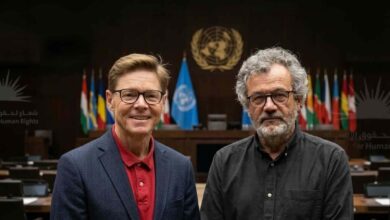
On Friday, June 28, 2024, during the 56th session of the Human Rights Council, the country visit report of the Special Rapporteur on the right to freedom of assembly and association to Algeria in September 2023, prepared by the former mandate holder Clément Nyaletsossi Voule, was presented by the new mandate holder, Gina Romero.
The Special Rapporteur visited Algeria, with government approval, from September 16 to 26, 2023. The purpose of the visit was to assess the implementation of the rights covered under the mandate, identify challenges and promising practices, and make recommendations to assist in compliance with the law and international human rights standards. During the visit, the Special Rapporteur met with government officials, representatives of civil society, lawyers, unionists, journalists, members of religious associations, and human rights defenders.
The authorities informed the Special Rapporteur that Algeria is drafting 44 laws to align national legislation with the 2020 Constitution and international standards, as required by the Constitution within a “reasonable period.” However, the Special Rapporteur found that, more than three years since the adoption of the 2020 Constitution, many national laws that conflict with and undermine the constitutional protection of human rights remain in force. These include Law No. 12-06 on associations, Basic Law No. 04-12 on political parties, and Law No. 19-91 amending Law No. 28-89 on public meetings and demonstrations, as well as new laws such as Law No. 23-02 on the exercise of trade union rights, Basic Law No. 23-14 on media activity, and the Penal Code, notably Article 87 bis. The Special Rapporteur expressed the opinion that three years is not a “reasonable period” and urged the authorities to prioritize new laws that enhance the enjoyment of public freedoms, in compliance with Algeria’s international obligations and the aspirations of the 2020 Constitution.
During his visit, the Special Rapporteur requested a copy of the draft laws on associations, public meetings and demonstrations, and political parties. In response, the Ministry of Interior provided short summaries of some provisions and promised to provide full copies of the draft laws. However, more than seven months later, the Special Rapporteur had not received the full copies, making it impossible to assess their compliance with international human rights standards.
In discussions about the restrictions on civil space, government officials justified their control over civil space by citing the threat of violent extremism and terrorism and ongoing concerns about public security and stability. However, the Special Rapporteur found no evidence to support this fear, noting that the peaceful and civil spirit during the Hirak demonstrations suggested otherwise.
The Special Rapporteur’s report highlighted statements that portray civil society negatively or endanger it, particularly those from senior officials, referencing repeated statements by President Abdelmadjid Tebboune during press engagements.
The report expressed concern about the ongoing repression and intimidation of individuals and associations critical of the government, and the continued use of unconstitutional laws and practices from the pre-Hirak period to severely restrict the exercise of the right to peaceful assembly and association.
Finally, the Special Rapporteur recommended that authorities treat civil society as a valuable partner rather than a threat. He insisted on cooperation with the government and the Algerian people to build mutual trust and fulfil the state’s obligations under international human rights law, providing the following recommendations to the Algerian government:
- Drop charges against those who exercised their right to peaceful assembly, association, or expression, both offline and online, and release all Hirak detainees.
- Publicly recognize the important work of civil society associations and avoid statements, especially from senior officials, that portray civil society negatively or endanger it.
- Lift travel bans imposed on civil society actors.
– Review the compliance of existing laws with the Constitution and Algeria’s international human rights obligations, prioritize adopting new laws that enhance the enjoyment of human rights and public freedoms, and ensure that new laws do not contain restrictions that undermine constitutional rights. Laws should be proportionate and necessary, aiming to facilitate rights rather than suppress them. Notably, repeal Article 87 bis of the Penal Code, ensure that anti-terrorism legislation is clear and specific, repeal and replace Law No. 12-06 on associations, Law No. 91-19 on public meetings and demonstrations, and Basic Law No. 12-04 on public meetings and demonstrations, amend Law No. 23-02 on the exercise of trade union rights, and amend Articles 75, 79, 95 bis, 96-98, 100, 144, and 196 bis of the Penal Code to ensure that those provisions are clear, specific, and cannot be used to deprive the right to peaceful assembly, association, and freedom of opinion and expression, both offline and online.
SHOAA supports the findings and recommendations of the Special Rapporteur’s Report on Freedom of Assembly and Association concerning the country visit to Algeria from September 16 to 26, 2023, which was presented on June 28, 2024, during the 56th session of the Human Rights Council by the new mandate holder Gina Romero.
SHOAA concludes that the Algerian government continues its campaign of repression against civil society and the public sphere, reflecting the extent of human rights disregard despite the guarantees provided by the government during the Universal Periodic Review at the UN Human Rights Council in March 2023 to improve the situation, release detainees, and lift restrictions on freedom of opinion and expression. This is further evidenced by the government’s failure to fulfil its promises to disclose the content of draft laws on associations, public meetings and demonstrations, and political parties and to send full copies to the Special Rapporteur as promised, showing clear evasion and non-compliance with UN human rights mechanisms. This contradicts official statements made at national and international forums, most recently by Algeria’s official envoy at the current (56th) session of the Human Rights Council.
On the occasion of Algeria’s 62nd Independence Day on July 5, 2024, commemorating the significant sacrifices made by the Algerian people for freedom and their great struggles to reclaim their fundamental rights, SHOAA calls for the immediate release of all prisoners of conscience detained either for expressing their opinions or for their political activities, and for dropping charges and annulling sentences against all detainees merely for exercising their rights.
**Read the Special Rapporteur’s Report on Algeria, click here